A bath mat and shower area? 4 logical choices that will make your purchase a waste

In many households, buying a bath mat is often considered a trivial matter that can be done casually. As long as the size is about right and the word “non-slip” is prominently displayed, it seems like it’s usable. However, problems only begin to surface after using it for a while.
Some mats always warp in the bathtub, some become slippery after only a few days in the shower, and some, despite being labeled as non-slip, actually become more dangerous when wet. As a result, many people develop the misconception that bath mats are inherently not durable. In reality, it’s more likely that the wrong usage logic was chosen from the start.
The bathtub area and the shower area may both seem like part of the bathroom, but they differ fundamentally in terms of water volume, water flow, standing posture, and usage time. If you don’t choose a bath mat that suits these two scenarios, you might end up with a situation where “it can be laid out, but it’s not suitable for use.” Choosing the wrong logic can render even the best materials and the most expensive items a waste of money.
This article will focus on two typical scenarios: bathtubs and shower areas. Starting from practical use, it will break down four easily overlooked yet crucial selection logics. Understanding these logics will reveal that a bath mat isn’t something that “anywhere will do,” but rather that “it’s only safe when placed in the right location.”
Why can’t the same bath mat be used in the bathtub and shower area?
In daily life, many families make mistakes when choosing a bath mat because they subconsciously assume that the only difference between bathtub and shower areas is the amount of water they need. However, in reality, the requirements for bath mats in these two different spaces are almost completely opposite.
Let’s first look at the interior of the bathtub. The space inside a bathtub is relatively enclosed, unlike other open spaces. Its bottom has a unique shape, usually curved or with a slight slope. This design has its own rationale, but it also somewhat restricts the user’s movement. When a person stands at the bottom of the bathtub, the position of their feet is basically fixed, and the range of motion is very limited.
In the bathtub, most of a person’s movements are lifting their feet, sitting down, and getting up; these movements mainly result in a vertical shift in the center of gravity. In other words, a person’s activities in the bathtub are relatively static, with movements primarily revolving around the vertical shift of the center of gravity.
Looking at the shower area, it’s an open space, a stark contrast to the enclosed space of the bathtub. During a shower, water continuously washes the floor, and due to different floor designs and layouts, the drainage speed varies in different areas. People in the shower don’t stand still; they constantly turn, move, and adjust their position to ensure all parts of their body are fully wet—a typical dynamic usage scenario. People in the shower area have a large range of movement, and their actions are frequent and varied.
These different usage scenarios mean that bath mats need to emphasize the characteristics of “fit” and “adhesion.” Because of the unique shape of the bathtub bottom and the relatively fixed movement of people within it, only a bath mat that fits well against the bathtub bottom and adheres firmly can ensure safety and comfort during use.
Shower mats, on the other hand, emphasize “stability” and “abrasion resistance.” Since the shower area is a dynamic usage scenario with constant water flow, the mat must be stable enough not to easily shift due to movement or water impact, while also possessing good abrasion resistance to ensure normal use even under prolonged water pressure.
If the differences between these two areas are not considered, and the same standard is used to select a bath mat, then obvious discomfort can easily occur in either the bathtub or the shower area. For example, the mat might not fit properly in the bathtub, causing slippage, or the mat might be unstable and shift due to water in the shower area.
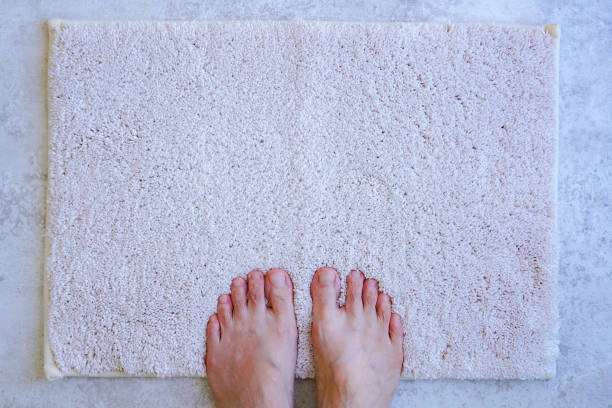
First principle: Different anti-slip methods, such as adsorption and friction, cannot be used interchangeably.
In a bathtub, the key to anti-slip isn’t the amount of friction, but rather whether the bath mat can firmly “stick” to the bottom. Bathtub surfaces are usually made of smooth enamel or acrylic, which are very compatible with suction cups. A suitable bath mat often relies on a large number of well-distributed suction cups to form a stable adhesion to the bottom, making the mat almost impossible to move as a whole.
a bath mat that relies primarily on suction in the shower area, problems will immediately arise. Shower floor tiles are often non-slip, matte, or textured ceramic tiles, with uneven surfaces, making it difficult for the suction cups to form a complete vacuum. In such cases, the suction mat may actually lift up due to localized failure, increasing the risk of tripping.
Conversely, shower areas rely more on the material’s inherent wet friction and weight-based stability for slip resistance. Even without suction cups, this type of bath mat can resist the impact of water flow and footsteps through friction with the floor. However, if such a friction-type bath mat is placed in a bathtub, the bathtub surface is too smooth, and it may actually slide entirely.
The second logic: Drainage capacity determines whether it becomes increasingly slippery with use.
One of the biggest differences between a bathtub and a shower area is the way water is present. The water in a bathtub is usually in stages, with noticeable changes in water level as you fill, shower, and empty. In contrast, a shower area has a continuous flow of water, constantly washing the floor.
In a bathtub, a bath mat needs to quickly drain the water film from the soles of the feet to prevent slipping, but the overall water volume is not large. As long as the surface has basic drainage holes or a textured surface, it will meet the needs. On the contrary, if there are too many or too large drainage holes, it may affect the feel underfoot and make people feel unstable.
The shower area is completely different. If the continuous flow of water cannot drain away quickly through the bath mat , a “water mat layer” will form between the mat and the floor. This layer of water significantly reduces friction, making the originally non-slip mat increasingly slippery. This is why many people find that the mat is fine when first laid out, but becomes dangerous after a while.
Therefore, shower bath mats must have a highly efficient drainage structure so that water can be quickly squeezed away during stepping. If a bath mat with poor drainage is used incorrectly , the problem may not be apparent in the short term, but with long-term use, it will become noticeably less stable the more you step on it.
The third point of logic: Different usage postures have drastically different requirements for stability, with significant differences.
In the specific context of using a bathtub, the movements people make are mostly linear, going up and down. For example, slowly sitting into the bathtub, then steadily standing up when you want to get out, and carefully stepping out of the tub. These movements primarily require the bath mat to prevent displacement at key pressure points. In other words, as long as the mat remains generally stable, the localized foot feel doesn’t need to vary much; even a relatively uniform feel won’t affect stability during these movements.
In the shower area, a person is almost constantly in motion. They might turn to rinse off the water, reach for something, or adjust their position to find a more comfortable shower angle. Throughout this process, the direction of their steps and the angle of force applied are constantly changing. This frequent and complex change places extremely high demands on the dynamic stability of the bath mat. If the bath mat cannot provide timely frictional feedback when the force changes, a person can easily lose their balance when turning, potentially leading to falls or other dangerous situations.
This explains why some bath mats are “slip-free when standing, but slippery when walking.” These bath mats perform adequately under static conditions, meeting basic anti-slip requirements. However, once in dynamic use, their design flaws become glaringly obvious. Therefore, the key consideration for bathtub use is stability when stationary, while the key consideration for shower use is stability in motion. These represent two completely different safety principles, and both must be given due consideration in the design and use of bath mat.
Fourth point of logic: Cleanliness and dryness directly affect long-term safety.
Many people only consider how well a bath mat works in the short term when choosing one, neglecting long-term maintenance. Bath mats can usually be easily removed after each use and either stuck to the tub wall or hung to dry. Their drying conditions are relatively controllable, and with good habits, mold and odor problems are not significant.
Shower mats are often left on the floor for extended periods, especially in bathrooms without separate wet and dry areas, where they are repeatedly wetted almost daily. If the material is not suitable for frequent wet environments, water can easily accumulate at the bottom, bacteria can grow, and this will affect the mat’s anti-slip performance.
mats that are not moisture-resistant and do not dry easily are left in the shower area for a long time, they will quickly become sticky, develop odors, or even become slippery. This change is often gradual, and by the time the user realizes the danger, the mat is no longer safe.
Why do many people feel that a mattress “doesn’t last long”?
When a bath mat is used incorrectly or in an inappropriate location, its performance deteriorates much faster than under normal use. This isn’t because the mat itself is of poor quality or cannot withstand prolonged use, but rather because the actual usage environment exceeds its original design limits. For example, if a bath mat is constantly exposed to running water, the suction cups used for securing it will gradually lose their adhesive ability and become ineffective. Similarly, if a shower mat is mistakenly used as an absorbent mat, water will accumulate on the bottom, making it slippery during use. Users often mistakenly attribute these problems to the mat’s “poor quality.”
In fact, as long as we follow the correct selection logic when using mats, that is, choose the appropriate type of mat according to different usage scenarios and needs, the lifespan of most mats will be significantly extended in actual use, and their safety performance will also be significantly improved.
Summarize
Bath mats are not a generic product that can be placed anywhere. The differences between bathtubs and shower areas dictate completely different requirements for bath mats . Anti-slip mechanisms, drainage capacity, dynamic stability, and long-term drying conditions are all crucial factors. If any one of these is chosen incorrectly, the mat can easily lose its original purpose.
The truly smart choice isn’t to buy the “most non-slip” mat , but the “most suitable for this position .” A sense of security only truly arises when the mat is placed where it’s meant to be, rather than remaining merely a label or advertisement.